Pages

Thursday, 23 January 2014

Final days in Greece

Two weeks after leaving Greece we thought it way past time we wrote a final note about our time in Greece, so here it is .....

Towards the end of our stay we had access to a hire car which allowed us to see more than just the area we could cover on foot. Our first excursion was over to the other side of this peninsula to the Venetian fort of Methoni, as mentioned in a previous post.

The Arcardian Gate in the walls of Messene
Our next trip was to Ancient Messene. 
This is one of the best classical sites in Greece, just not well known due to the remoteness. The first thing we noticed was the sheer scale of the place. As a city it is protected by mountains on three sides and huge stone walls – almost 10kms of them – remnants that stretch up the sides of these mountains. Like many of these Greek sites there are remains from early times mixed with Roman, later Greek and Byzantine ruins. It has a particularly good amphitheatre and a stadium with many of the stone seats and columns still remaining.
The Stadium

The Monastery
After a couple of hours walking around the site (with, perhaps, four other tourists) we headed up to the village for lunch.  We had our first real Greek salad and seven-hours-in-the-oven pork. Melt-in-the-mouth delicious and with a great view over the ancient ruins. We then headed up the mountain behind the town on a very rough track that was a challenge for our little Daewoo rental car. At the top was an old monastery that is now closed except for once a year when the locals overnight there for a religious festival. The only inhabitants these days are goats.  They mainly inhabit the surrounding countryside, but occasionally careless people leave the gates open and the goats do what goats do, so it's a bit of a smelly place.

Frescoes inside the monastery
Frescoes on the ceiling

The windy road
Another day trip was to Sparta, home of the legendary warriors, the Spartans. Now it is a new town called Sparti, due west from Kalamata, but the road needs to cross some high mountains and very rugged land to get there. Due to the mild winter there were only traces of snow on the tops and the road was clear for us.  We likened the road to that between Arthur's Pass and Otira villages, before the viaduct was built, and repeated about eight times!  Numerous hairpins later we arrived in Sparti and found it to be more modern, neater and cleaner than the few other
Orange trees in Sparti town
towns we’ve seen in the Peloponnese. There are plenty of orange groves nearby and trucks full of loose oranges. Even the streets have orange trees which look wonderful. We did pick a couple but found them full of pips. Maybe more ornamental then. Apart from a small museum with lovely mosaics, there isn’t much else to see in town (unless you have a budget that includes lots of shopping!), but up behind is the village of Mystras. This is on the mountain where the Spartans left their newborn males to see if they were tough enough to survive the night.

Mystras
Mystras was once one of the most important towns in the region, even becoming the second home of the Byzantine emperors in the 13th and 14th centuries. It is now a World Heritage Site. Unfortunately we arrived at 3pm, closing time, so we just saw the ruins from outside.


This period included Christmas and New Year.  It was undoubtedly difficult to be so far from family, especially for Christmas.  But on Christmas Eve we were kindly included in a party for expats held at a nearby village.  We met several interesting couples there.  Many spent part of their year in Greece and the other part at 'home'.  One of the women was Kiwi, though she'd spent a good proportion of her life in Oz.  She and her husband kindly invited us to visit them at their Koroni home so we popped in for a cuppa and cakes late one sunny Friday morning.  We sat chatting on the deck of their modern apartment, with glorious views overlooking Zaga Beach and the Ionian Sea.  Jackie is an artist - you can enjoy her work here.  Their spare bedroom is Jackie's studio, but she also runs classes in the village.  Peter's an ex-plumber who, among other things, is currently learning to play an electronic keyboard - he has it sitting in front of their huge telly, which is connected to his laptop - he uses YouTube to get free lessons and sits there and plays.  We enjoyed their company immensely, are impressed by their lifestyle and are very grateful that they showed us it's possible to live very well and inexpensively in Greece.

The day finally came to be leaving Koroni. While we will miss the friendliness of the locals and the amazing winter weather, it was an isolated place without our own transport. Our coach trip back to Athens was a very Greek experience. Waiting at Harakopio for the 8am bus we saw it heading in the opposite direction five minutes before it was due to pick us up - that is, it was going to be late. When it eventually arrived it was a very slow trip up to Kalamata with the driver busy chatting to a group of friends he picked up along the way. Sometimes one arm is needed to talk with, sometimes both …

Looking out the bus window - Mycenae!
The ”express” bus all the way through to Athens decided to change a couple of times at the Kalamata bus station but we eventually got underway with a new driver. This one followed the rule of no smoking on the bus, unless you are the driver. He also specialised in racing up to the toll gate barriers and getting through just as they opened.  As we had the front passenger seats it was a very disconcerting experience!  He also reinforced the rule that stop signs and red lights are more of a guideline than an actual reason to stop …

Street art in Athens
Four days in Athens was just the right amount to take in a few more classical sites, museums and shops at a leisurely pace. It has a cheap, clean, modern and reliable metro so getting around the city is easy. There are many excavated ruins dotted around, some with archaeologists actively digging. As we found last time, there are cafes everywhere and they are full of locals. What recession? One of the highlights is the very new Acropolis Museum. It is at the base of the Acropolis and built over excavated ruins which can be seen through the glass floor in places. There are also some pointed notes that it contains all the artefacts gathered from the Acropolis, except for those stolen by the English thief Lord Elgin.
The main Archaeological Museum also has enough statues to tire one out quickly. It is certainly a vibrant city with a lot happening, from some rather nice suburbs to the more normal graffiti-covered areas like around our hotel. A convenient location but not the most desirable. 


Temple of Hephastion

View of the Acropolis

Feeding the feral cats in Athens


Saturday, 28 December 2013

Health and Safety in Greece


A few things we’ve spotted recently have all come together as a bit of an eyebrow raiser – it’s a land of contrasts.

The Good

We saw a pre-school with several plastic ride-on toys accompanied by a line-up of red cycle helmets.  Helmets must be an EU regulation for licensed childcare premises.  Seems a bit over-the-top, but then my son and most of the people I know survived pre-school without brain damage. 

Walk into a bar on a Friday night at home and almost everyone will be drinking alcohol.  Here, people (even young people) will rarely drink alcohol before 9pm.  Young people are more likely to be sipping on a frappe.  Here (as in Italy) it’s usually the tourists who drink to excess.

Spot the two large glasses of water!
In every café, bar or bakery where we’ve sat down to eat or drink they have always served us a large glass of water too, free of charge.


The Bad

Takeaway lunch
Helmets are compulsory here, but the law doesn’t specify that you need to wear them on your head.  It’s normal to see people zipping, or chugging, around on scooters and motorbikes without helmets.  Sometimes they'll comply with the law (if not the intent of it) by wearing it slung on their arm.  Children are often transported helmet-less too.  It looks like fun, but don’t do this at home!


It’s illegal to smoke in enclosed public places in Greece, but you wouldn’t know it.  Restaurants, cafes and bars are usually smoky, sometimes very smoky.  However, the only person we’ve seen smoking on a bus is the driver.  Cough, cough!


 In Greece (as in Italy) they do not have rubbish collection at the door – you need to take your rubbish to large bins along the road, which are emptied on a regular basis, usually.  These bins are usually ‘home’ to several feral cats, so you need to take care to not startle them.  I got a hell of a fright one day when a grotty looking moggy shot out of a bin in front of me as I off-loaded a bag of junk.  The SPCA would be running in circles here.

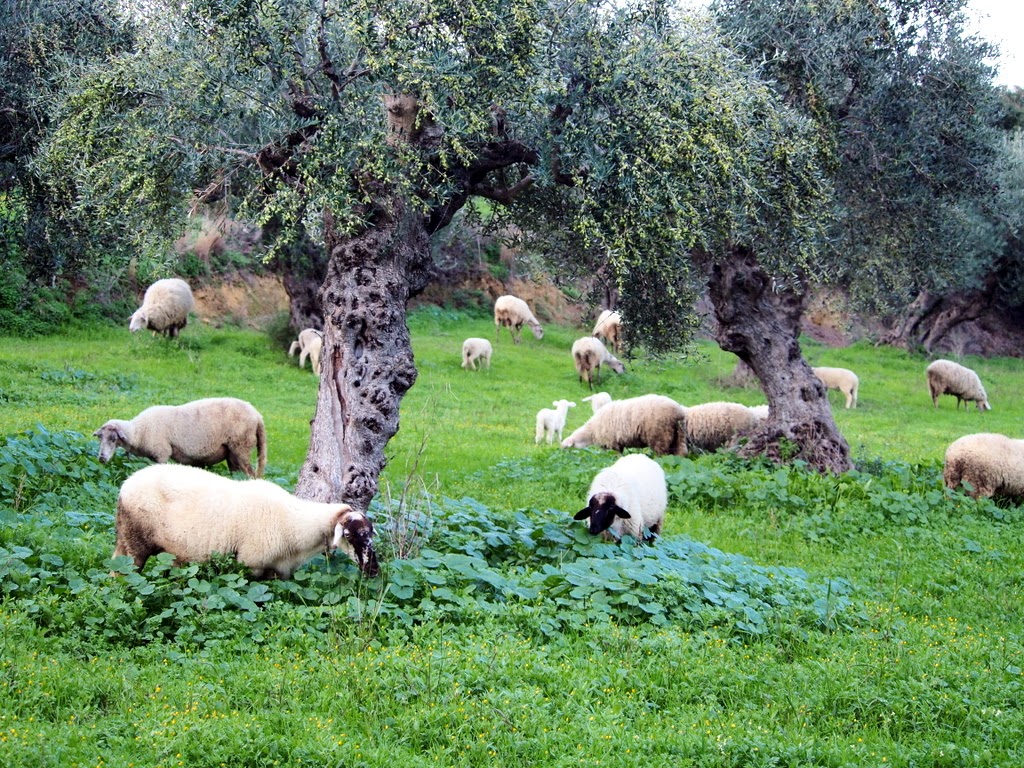
Imagine a paddock of olives trees partly enclosed by a fence.  Said fence consists of upright posts standing about a metre tall and connecting said posts is a twisted line of two lengths of rusted barbed wire.  Keep your children on a leash at all times!


Our hosts took us to their favourite local restaurant one evening and the owner nabs him (an architect in his previous ‘life’) to discuss the building work he’s planning to do the next day.  He was planning to remove a load-bearing wall upstairs and wanted to know if the planned supporting beam was strong enough.  Lucky we turned up that evening.  His planned beam was far too small.  He went ahead the next day but went with the concept that if double the size is required, quadruple must be better!  Our host is now concerned that the old mud-brick walls may not be able to handle the huge weight of the reinforced concrete beam.  In future we’ll try to make sure our downstairs table is not under that beam.  Looks like the EU doesn’t have a hand in building safety standards, yet!

Chainsaws are used to remove olive tree branches during the olive harvest - you can read more about it in our earlier post.  Does anyone else hear alarm bells ringing when someone mentions climbing a tree, with or without a ladder, with no protective gear, and a running chainsaw?


Friday, 27 December 2013

Of castles and (more) olives …

Methoni
After six weeks here we have been getting a bit stir-crazy. Winter time in rural Greece is very quiet, apart from the buzzing of chainsaws (a vital piece of olive harvesting equipment). We’ve walked to the nearest town (Koroni), our local village and supermarket (Harakopio), down to the beach, and to the other nearby villages. Many times. Though the scenery is lovely: olive groves, sea, sand, mountains, white houses, and more olive groves, we’ve felt the need to get out and explore.  We have taken the local bus to another nearby town but it is much the same. Luckily we now have use of a rental car so we put it to good use last weekend with a drive over to the other side of this peninsular.

Typical village
The Peloponnese are mountainous so most of the inland roads are narrow and very windy. The interior is almost exclusively olive groves. Very agricultural. So we headed due west across to the other coast, to the village of Methoni.


Now a quick historical interlude … after the fall of the Roman Empire (which controlled Greece at the time), the Eastern Roman Empire (Byzantine), out of Constantinople (now Istanbul) took over. They had some control of Greece until the start of the Crusades, one of which sacked Constantinople. The Europeans (collectively known as “Franks”) took over parts of the coast to protect their fleets on the way to the Middle East. The Venetians also arrived to build castles to protect harbours for their fleets. Then the Turk arrived during the Ottoman Empire and controlled Greece till the 1820’s when it became independent. Hence most of the castles dominate ports and were variously built and extended by Franks, Venetians and Turks.

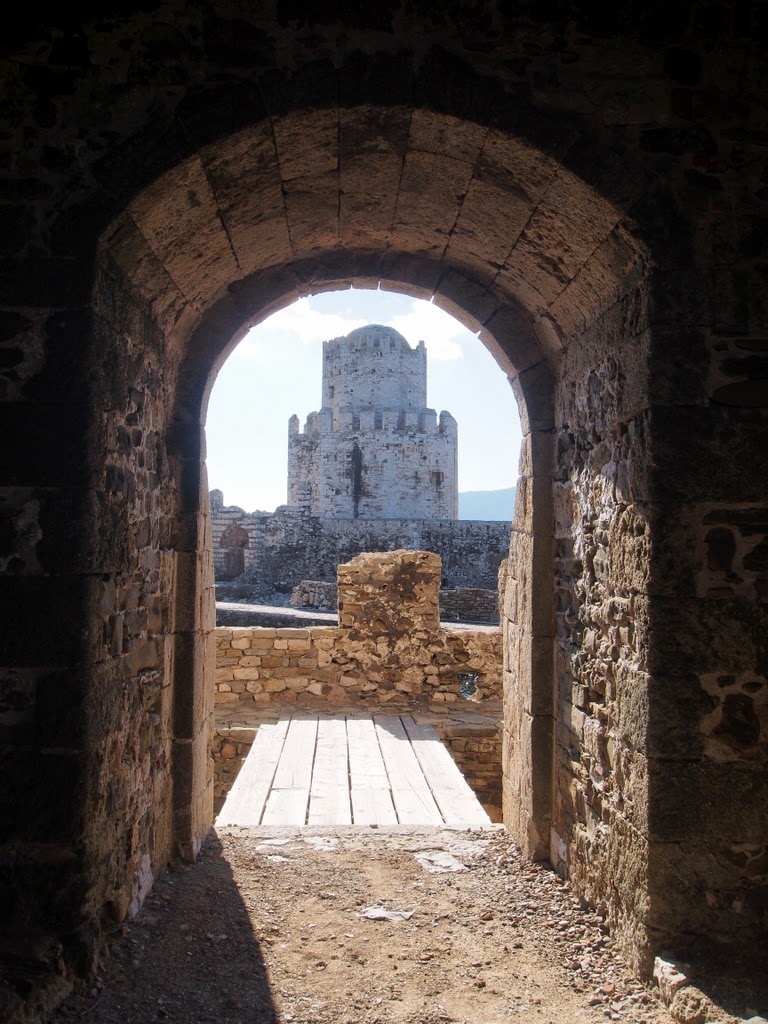
Koroni and Methoni are “twin” forts, both built by the Venetians and later enhanced by the Turks. Koroni is impressive but Methoni is magical. It has the full walls around a peninsula with towers and tunnels to explore, along with the remains of some old buildings. It is big enough to have contained an entire town, though the French shifted that inland in the 19th Century. The walls are very strong with many openings for cannon. At one stage 7,000 Venetians held out 100,000 Turks until four supply ships arrived. They got so excited (Italians!) that they rushed to the ships and left the walls, the Turks promptly overran the fort and butchered everyone.

 Note the three stone cannonballs


On a glorious sunny day we spent several hours wandering all over the place, and only met three other people there. Being winter, the gate was open and no admission charge. We recuperated at a nearby café where we splashed out on a real meal rather than the pastries we normal economise with - the meal was fabulous.  We sat outside in the sunshine, partly to avoid the smoke from the locals inside. While there an old guy arrived on his scooter to sell the café owner some vegetables, followed by a couple of guys in a van with a selection of cheeses, which we were invited to sample. In the past it was common for people to load up their donkey (or van these days) and spend weeks roaming around the countryside selling off their produce. Whenever we are in the local towns we often here a loudspeaker, it comes from one of these mobile shops advertising their wares.


Nice views - and more olives!
The coast road north is interesting – if you like olives – and it takes you to the attractive town of Pylos (or Pilos*), laid out by the French in the 19th Century. We thought it the most attractive town we have seen recently, nicer than Koroni. It has a lovely deep-water harbour – Navarino Bay, the site of an Athenian victory over Sparta and, 2,500 years later, a naval battle where the Turks were defeated, which led to Greek independence. Along the northern edge of the bay are long sandy beaches with closed-down restaurants and the remains of a Frankish castle on a hillside. We almost made it walking up to the castle but got attacked by some vicious natives. Many bites later we retreated to the car and protection from those mozzies … they even dined through clothing, landing on us as we walked, despite the breeze!

Farnkish castle at Navarino Bay

Also near the top end of the bay is “Nestor’s cave” where many ancient Greek tablets were found dating from Homeric times. There is so much history here in Greece, mostly ancient as it is hard to tell how old the houses and towns are, but there are the various castle remains (13th - 17th Century), the odd Turkish-era well, quite a few old Byzantine churches, and then the really old classical Greek remains.

Olives arriving at the Mill
We wandered back home via some very windy roads in the interior past, you guessed it, mostly olive groves. The locals were out harvesting some and at one stage we came across a mill which was full of people and their piles of sacks. A good day out in the mighty little Daihatsu which may, or may not, have been insured. We ring up when we want the car (it is parked in our drive all the time) and the rental company are supposed to book insurance for the day. I suspect they only do it after an accident …


* Note that there are several different spellings of many place names as there is no direct transliteration from the Greek alphabet to our Latin one. Our local village is marked on maps as Harakopio or Charakopio.

Monday, 23 December 2013

Olive Harvesting Greek-style

I thought Italians were excitable but they seem positively Germanic after a couple of days olive harvesting with the Greeks. We were subcontracted out to help a local harvest his trees.  He is a market gardener and certainly knows how to produce a good olive crop. While most people are getting a fraction of their normal crop this year he has a few spectacular trees. While we made do with three and a half 70kg sacks of olives from this entire place (38 last year!), our first two trees at Yorgo’s produced four sacks, that’s 140kg per tree for the mathematically disinclined. Admittedly they were huge trees and difficult to pick – they were well watered and probably well manured too. He has a plentiful supply of the latter from his chickens and goats.

Harvesting Greek-style is “different". Like the Italians, it starts with putting down the nets on either side of a tree. Then comes the arguments about where the nets should really go: good, full-bodied shouting matches, and this is just between the three generations of family members!  After a couple of reshuffles someone hops up the tree with a chainsaw running but without any sort of protective gear. Various olive-laden branches come crashing down while everyone else whacks at the remaining branches with a nervous eye looking upwards. They use sticks the size of walking sticks for the lower branches and long poles with a plastic fork attached for the higher ones. Hitting the branches as hard as possible seems to be the aim, olives fly in all directions. Often they land on the nets.

A local on the threshing machine ...
One useful invention is the use of the threshing machine.  This strips all the olives off a cut branch very quickly and feeds it into a sack – very efficient, though it also propels olives everywhere else too. Of course there is no protective equipment anywhere, we managed to use work gloves and wore hats which help ward off the torrent of olives when someone is hitting a branch on the same tree or using the thresher nearby. Safety goggles? We took some the second day once we realised the risk but they were not offered and no one else bothered. Strange when olives are hard and eyeball sized…

The worst of the twigs and branches get raked off the nets and then the olives get put into sacks. Carrying these sacks around isn’t pleasant when they are getting full (70kg). We far prefer the Italian plastic bins for this, they carry 20kg and are easy to carry and stack. But we’d hate to break with tradition and be associated with [apparently] whimpy Italians.  We're with the Italians on this one!


Lunch makes up for all the hard work. Almost everything we had was produced on the farm, from all the vegetables, olive oil, olives, feta (from the goats), and lashings of wine. Bread was the only item bought. After a lot of eating, drinking and conversation (none of which we understood), we were back to work. This was a repeat of the morning but with even more vocal arguments over net placement (presumably due to the large intake of wine) and some unsteady chain-sawing.


Much as it was interesting, neither of us would volunteer for more picking in Greece. All the stick beating is hard on your body and, by not understanding the language, the somewhat illogical way they work is frustrating. Given the arguments then perhaps they get frustrated too.  For example, we saw a lot of olives missing landing on a net so we placed a spare one next to it to catch them. Nope, not the right thing to do. One of the family rushed in and dragged the net off to the side and left it in a heap so the olives kept being lost. Oh well.


For our efforts Yorgo kindly dropped over a large water bottle of fresh olive oil, which we tasted with our Christmas lunch.  Very green and peppery and, at this stage, still cloudy - it's wonderful!

Wednesday, 27 November 2013

Of thunder storms, olives, .... and earthquakes


Our local roads ...
After our first few weeks in Greece it is time to report in. Our first observation is that we’re glad we’re not elsewhere in Europe at this time of year! While winter approaches with single-figure temperatures further north, we’ve experienced temperatures consistently in the high teens or low 20s. Certainly warm enough to spend our working days outdoors in t-shirts and shorts. However, we have experienced rain – bucket-loads of the stuff - accompanied by lightning and thunder that rolls on for hours on end, thankfully often at night. These are the biggest and longest thunderstorms we have ever experienced by far – exciting for us indeed.

Koroni
Koroni alley
We are near the little harbour town of Koroni, near but not in. We usually walk into town at the weekends, avoiding the main road so we can avoid certain death at the hands of Greek drivers, and taking the single-lane concrete and mud tracks through the olive groves. Even when we resist stopping every few minutes to exercise our cameras it still takes about 1¼ hours to get there. Koroni is a bit of a tourist town – white-washed houses, restaurants along the water front, little alleyways between houses, and a few gift shops. Indeed quite the opposite of most of the other little towns and villages around here – they are somewhat agricultural with most buildings and streets being in a state of disrepair.  Some of the smarter houses in the area are owned by foreigners who have departed for the winter. Koroni does have a Venetian-era fortress though which include huge bastions that you can venture inside of, as long as you don't pay attention to the large cracks in the ceiling...

Inside fortress


“Agricultural” describes this area at this time of year. Though there are quite a few houses for rent in summer when there will be plenty of tourists around, now we are probably two of very few foreigners around. In a normal year there would be plenty of Albanian itinerant workers around for the olive harvest, but not this year because of the low yield this year. All the land is covered by olives with just a sprinkling of grape vines (harvested for wine and raisins). And the car parks in town are full of utes or tractors and trailers with bags of olives in the back.


Greek is a difficult language and we haven’t made much of an effort yet apart from saying  Hello, which always elicits a friendly response from the locals. They’ve seen us wandering around the roads and village often enough now to recognise us. We’re lucky that we’ve met quite a few of the locals via our hosts, Michael and Maria.  They are well integrated into the local community and, having good Greek, have many friends and acquaintances locally. One of the local restaurants has live music each Friday night, and our hosts have taken us there. Greek music? Interesting! We also had a big party here a few weeks ago. Greeks don’t celebrate their birthdays but almost every day of the year is a “name day” (yiorti) where everyone with that day’s name gets to celebrate together. Certain days are more popular than others as there is traditionally a very limited set of first names to choose from: in this area there appears to be approximately six male names! Very confusing.

Food in Greece is always one of the highlights. And it is lucky that Greek food is varied and good as they don’t eat food from other cultures – don't bother trying to find an Indian restaurant in Greece (though there is a pizzeria in the local village).
Konstantina
Our elderly neighbour, Konstantina, only eats certain meals on particular days, e.g. it is Wednesday so it must be lamb and potatoes. And it must be cooked in the traditional way – our hosts remember inviting some locals and cooking a traditional meal, except she substituted sage for thyme. Some guests refused to eat it! And this is odd because Maria is an excellent cook. She provides a big lunch for us each work day, so we only have to find a light dinner for ourselves, and it really is a highlight. Plus we are lucky to have an endless supply of the best home grown olives, olive oil, jams and chutneys, and wine...and we pick fresh oranges from the tree half a minute from our front door.  Today, while we were sweeping the road in front of Konstantina's house, she invited us to pick ten oranges from her tree behind her house.  She speaks no English and we speak no Greek.  She stood at her window, showed us an orange, pointed to us, pointed to the orange then each of her ten fingers and thumbs and pointed to her tree.  We worked it out and many smiles and patting of tummies seemed to confirm we'd interpreted the conversation correctly.  One of many precious experiences!


We're not sorry to have left behind earthquakes in New Zealand, but it seems rather ironic that we've come to an area that has centuries of active earthquake activity.  So far we have not experienced any here.  Right now we find ourselves with Kalamata less than an hour's drive away.  Until we arrived here, the name Kalamata meant only olives to me.  I had forgotten I'd visited there briefly in 1985.  On September 13 1986 it was hit by a 6.0 earthquake.  A quarter of the population, of 40,000, were left homeless and more than 3000 buildings were destroyed.  Twenty people were killed.  We spent a few hours in Kalamata a week ago.  It was very sobering.  28 years after the earthquake there are still several half-standing old buildings in the main city streets.  You can walk up a lane between modern buildings and be met by a very old stone wall that blocks further progress - the area beyond is a shell, half covered with opportunistic plants.  In the suburban areas at the very edge of the 'CBD' there are old stone walls at the edges of modern apartments, empty sections with stone staircases leading nowhere, and hollowed out buildings being reclaimed by greenery.  Very sobering.


At work

At play
Our work here has been quite varied: sanding and oiling outdoor furniture; harvesting olives; investigating and recommending a new mobile phone; bottling olive oil; packaging orders for products; mopping out one of the villas here when it got flooded during a storm; sweeping; installing a plastic covering on the pergola to give extra outside workspace; feeding the cats while our hosts were away for a couple of days (which happened to coincide with the worst of the storms we've experienced so far).

The olive harvest has been particularly disappointing for the locals this year with most growers getting about 10% of last years crop, apparently due to adverse weather conditions at important stages of the growing season, and not helped by the storms that have seen many ripe olives knocked off the trees. Here, at the Icon Painter villas, last year they harvested 38 70kg sacks of olives.  This year we nearly got three and a half sacks!  It's very sad.
Both here and in Italy we've been spoiled with fabulous fresh extra virgin olive oils.  Nigel asked me the other day if we'll go back to buying cheap, tasteless extra virgin oils when we get home ..... not a chance!!  A good oil is so good for you and simply tastes great. 

And what would Greece be without cats everywhere?


Monday, 18 November 2013

Geia sas (Hello to Greece …)


Departing Italy was depressing, exciting, and surprisingly easy at the same time. Taking a comfortable and fast train to Rome was easy, and also cheap as we remembered to book well in advance when the few “special discount” tickets were available. Travelling with Aegean Airlines to Athens was a pleasant experience, it was the first time we had used mobile check-in and boarding passes, i.e. the details were on our mobile phones and these were just scanned in directly from the phones. No queues at the check-in desk nor at the gate where we were allowed onto the plane early for a comfortable and on-time flight. All was looking good.

And remained good in Athens where we hopped onto the express bus from the airport with 1 minute to spare after being almost first through the baggage claim and, of course, being the EU there was no immigration to contend with nor apparently any customs either.

Despite the rumours of recession and desperation in Greece, we were surprised to see numerous department stores and luxury car dealers on the way into the city centre. This was followed by the crowds we found shopping at the numerous shops within Athens over the next couple of days. We have to report that consumerism is alive and thriving despite what you may hear on the news! Later we were told that Greeks generally distrust the banks and tend to invest in property and land and keep the spare cash under their mattress, hence it appears that it is only the banks that are in deep strife here.

Like most big cities Athens is crowded and chaotic, and exciting and interesting at the same time. Our hotel was in a pretty working-class area (that might explain why it was so cheap – only 33 Euros a night), which meant loads of local cafes, rubbish, dirty, and major graffiti everywhere. The graffiti was generally very artistic and photogenic.


November is clearly the off-season as the tourist sites were very, very quiet – everyone must have been shopping instead. Even the Acropolis was quiet with no queues and it was even possible to get some photos without other people in them. The views over the vast – and very white and smoggy – city are spectacular. There is so much to see here, and not just the classical sites and museums (of which there are many), that we could happily have spent several more days here. It is as full of life as it is of shops, including one of the best-stocked photography shops we’ve ever seen. Recession? What recession?


We departed Athens via the easy-to-use bus station on a comfortable coach driven smoothly by a very un-Greek-like driver. The trip across the Peloponnese to Kalamata was very scenic and reminded me why a previous holiday here by bicycle some years ago wasn’t all that successful – the interior is very mountainous! There are a few classical sites to see along the way – the Canal at Corinth (if you’re not blinking at the time), some big stone walls surrounding the top of a mountain peak, and signs to the wonderful amphitheatre at Epidavros, if only you could stop. The smooth trip is aided by the wonderful new motorway all the way, and the very few signs of human habitation to be seen, apart from the huge cooling towers of the coal-fired power station at Megalopoli.

All good things come to an end, and ours was the three-hour wait at the Kalamata bus station for the local bus down to Koroni. Unfortunately the bus station is nowhere near the centre of town so there is nothing to do except sit in the rather good café and while the time away. This last stage of the trip was somewhat epic as we had a proper Greek driver at last. I was a little concerned with the speed we were going and taking the corners, often in the middle of the road, plus the driving right up behind any car before lurching out and overtaking it on the short straights. I was a little more nervous when I realised he was doing it all one-handed so he could concentrate on chatting to his mate in the passenger seat. Then he got onto his cellphone for a long chat which was marginally worse, but deteriorated again when he dropped it on the floor and spent the next 10 minutes fossicking under his seat trying to find it, all the while continuing to drive in the same fashion. At times like this it is best to concentrate on the scenery and your insurance …

We got off the bus at Harokopio (if you're looking for it on Google maps, try Charokopio - an alternative spelling they tried for a while to get non-Greeks to pronounce the name correctly), the nearest village to our new hosts at The Icon Painter. Michael and Maria were there waiting for us and took us to their local restaurant where we were ushered into the kitchen to choose our dishes, then back to a table to enjoy some wonderful food and lashings of wine. A very promising start …

Friday, 8 November 2013

Farewell Italia (again)

After the entire month of October at Baronci, near Florence, it is time to move to our next phase – Greece. We are very sad to be leaving Italy as we’ve met some wonderful people, seen some amazing sights, had some great experiences, and fallen in love with the place and lifestyle. But, then Greece has a good reputation too …


Santa Brigida, seen from Baronci
Firstly some final words about 
Baronci. It was similar to most of 
our other locations in that it was isolated in the countryside and our own transport would have been a great help to see the local area, so we really only saw the farm, the local town Santa Brigida (possibly the most boring town in Italy), the road to Florence, and Florence itself. Plus a day-trip to Lucca (more later).We didn’t get out and about into Tuscany as much as we had hoped as we didn’t have that many days off and the buses weren’t good, however the trips to Florence made up for that.  It was comfortable living and we ate well – Marina kept her bargain and didn’t repeat any meals over the entire month, except for a couple we requested from her. Like everywhere we’ve been to in Italy the wine was good, cheap, and plentiful. Marina and her two brothers, Vanni and Mimmo were always interesting company as they are well travelled (particularly Africa) and have a very good sense of humour. I particularly enjoyed Vanni’s autobiography of his time in Africa. Still not sure about the stuffed Condor though … Marina was very good to us, taught us a lot about Tuscany, and made sure we didn’t work too hard when the body developed some aches and pains.

Lucca
Our one side-trip was to the Tuscan town of Lucca. Though not as well-known as the nearby Pisa, it is one of the attractions of Tuscany. It is surrounded by a wall and contains many old towers, one of which you can walk up to get a view over town and admire the trees grown on the top! The central piazza in the town is oval in shape, surrounded by houses and shops. We also enjoyed an exhibition at the Lucca Contemporary Art Centre of works by Henri Cartier-Bresson, the French street photographer.


Autumn arrived while we were here. Though many days were hot during the middle part, we did need the fire lit most evenings and there was a lot of rain during October, often accompanied by impressive thunderstorms. The lack of sunshine was delaying the ripening of the olives so that we only managed a few days of picking and they were still mostly green. Luckily we did manage to pick enough to be able to go to the press with them and sample the outcome.

And we did see two red squirrels as well! 


Our final few days were in Florence, staying with Marina and her son Lorenzo. Marina took us out to a restaurant serving food from Naples which was divine. The simpler the pizza the better. Florence was, again, glorious, with so much to see and do. Our personal highlights would be:
  • The walk up the 400+ steps inside the Duomo which first come out in a balcony inside the top of the central dome where you can stare down at the ants in the church or look at the amazing painting that covers the entire inside top of the dome. Then the walk gets even better as you carry on up and inside the two layers of dome – the dome is composed of one inside another, to keep it light and strong. The stairs lead between the two shells and finally outside to stunning views over Florence. Amazing.
  • Art. Everywhere. Whether it is the buildings themselves, reliefs scattered about on the walls of buildings everywhere, the numerous statues, or the galleries, there is just too much to take in at once.


You can, and we did, spend days walking around the centre going ooh and ahhh ..