Pages

Wednesday, 22 April 2015

Somerset

Any way will be interesting
We’ve just come back from a long weekend exploring the lanes in Somerset with my sister and brother-in-law Gail and Janos. The motorways are a great means for getting to, or returning from, an area quickly (especially when you can sit on 70mph for hours on end) but are unpleasant and you miss so much of the countryside. And that is what this trip was about, exploring the numerous back lanes and villages.

Our first stop was a return to Frome (pronounced Froom and rhymes with groom). Its big attraction is several streets full of interesting independent shops, many of the women’s clothing variety (sigh).

Nunney castle and moat
We wandered off and happened across a typical little village in the middle of nowhere – Nunney. Not only did it have a “gastro-pub” (ancient on the outside, very modern and smartly decorated on the inside), it also had the remains of a castle surrounded by a little moat. Very picturesque. Of course it wasn’t a very successful castle as the Royalists took cover here but then came along Cromwell’s men with cannon. That was the end of that. So it was time to head to our hotel via some lonely farmland on the Mendips (large hills or small bumps depending on which country you originate from).

Somerset farmland
Mendip village

Dinos on the rampage
We spent two nights at Wookey Hole – just a hamlet really – but famous for its caves and the legend of the Witch of Wookey. The attraction of the location was that it was just outside our favourite small city – Wells. And that the hotel was dirt cheap good value! Sadly this great natural attraction was blighted by dinosaurs.


Our second day out was spent mostly in Glastonbury, a very mystical town famous for a lot of events:
  • Joseph of Aramethea supposedly visited twice – once with the baby Jesus! – establishing an early Christian church, looking after the Holy Grail, and planting his staff into the ground which then sprouted into a thorn tree (which remained till four years ago when a vandal cut it down with a chainsaw, though cuttings were taken so there are other thorn trees still living). All these myths evolved during the middle ages, though the thorn trees clearly exist - strangely they flower twice a year – and a sprig is sent to the Queen who has it near her when she reads the Queen’s Speech each year.
  • Glastonbury Tor is a hill rising out of a very flat plain that used to be underwater, hence it is the mystical Isle of Avalon associated with King Arthur.
  • The Abbey was the biggest and richest in England and was a clear target for Henry VIII during the Dissolution of the Monasteries when it was destroyed, with everything of value taken for the royal coffers. Much of the ruins were then nabbed by locals for building their houses, so it is surprising that the remains are still impressive.
  • The monks in the Abbey, no doubt as a money-raising exercise, declared that the remains of Arthur and Guinevere had been found in the graveyard. They were re-interred in the Abbey and the pilgrims kept coming. It all disappeared after the Dissolution.
Four month old Poppy in a motorbike basket
Vicki bracing against the wind at the Tor

Glastonbury Tor
These days the highlights are: the walk up the Tor to the tower, all that remains of a 12th C  church, with wonderful views given how flat the land is nearby; the Abbey remains which are still very impressive; the annual Glastonbury Festival,; and the New Age hippies. The town is full of hippies and shops selling crystals, alternative medicines, hippy, witchy and steam-punky clothing, and New Age books, ornaments, wands and other paraphernalia. Fascinating, but no doubt dreadful during the peak of the tourist season.
Glastonbury Abbey


The following day we drove home the slow way. Above Wells on the Mendips is a radio/TV mast. After half a day of driving around little lanes in the vague direction of home we could still see it! At long last another gastro-pub loomed in the middle of nowhere. Literally. But with views across the fields to the Wells TV mast and also to Downside Abbey and School. The Abbey is the home to the Benedictine Order of monks in the UK and the attached school is a very exclusive private school (called Public Schools here, presumably because anyone can go as long as you can afford the £9,700/term fees). It has wonderful old buildings and extensive grounds in a tiny village miles from anywhere (at least by the lanes that we took).

Lacock Abbey
A modern version of this 1835 original
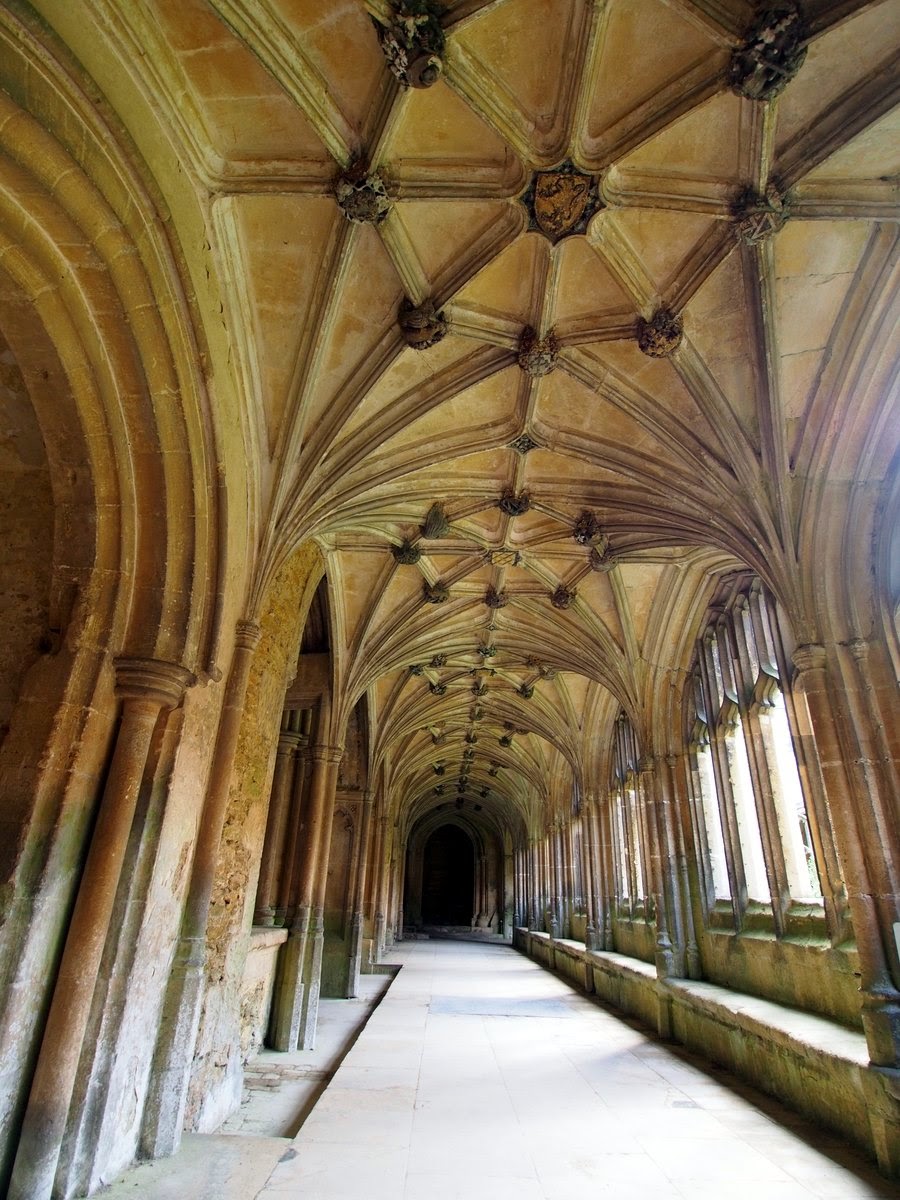
Last stop before tearing back on the motorway was Lacock Abbey. A nunnery since medieval times, it is now being promoted as one of the homes of photography as this is where Henry Fox Talbot developed the negative process and created some of the earliest prints. Like many of these stately homes it has changed owners and purposes many times in its history so suffers a little from a personality crisis. And, like many estates that have been handed over to the National Trust, most of the furnishings have disappeared and the Trust has to buy in a selection of suitable (to a particular era) items to stock the place. Hence the interior is a mishmash of ancient abbey (the cloisters were used in Harry Potter), Victorian, and mid-19C alterations. But the best part is the attached village which is all historic and original – with buildings still lived in, but no TV aerials or the like in view as it is often filmed.
Lacock village
Lacock village


So the end of another break and a reminder that England is full of little surprises in odd corners.


Tuesday, 7 April 2015

Spring update

Without talking about the mundane it has been hard to find inspiration during the winter period when we’re “getting on with life” rather than being involved in an adventure. But the reality is that life is very interesting here and we’re loving it. This part of Berkshire is quite rural and consists of numerous little lanes linking up small hamlets and villages, plenty of farms and little woods everywhere. We enjoy waking up each morning to views in one direction across 'our' big garden to the surrounding countryside, to the other side into 'our' forest, and think how lucky we are. It is certainly a huge contrast to this time last year when we were flat-sitting in Reading and only had a bleak cityscape to look at.

Welford Manor
We joined the National Trust here which gives us free access to numerous big stately homes and gardens and motivates us to get out in the weekends and see the area. Spring has arrived late this year. One month into it and it still only creeps up to 10C most days and is often cloudy; some rain but rarely enough to see me heading inside from the gardening.

Snowdrops
The flowers in Spring are impressive here as it goes through the cycle of snowdrops, crocus, daffodils, and then bluebells. For the best snowdrop display we went to nearby Welford Park which is only open for a short period. They have planted millions of bulbs that make it really look like snow has fallen.


Another nearby place we visited (principally because it is free to National Trust members) is The Vyne, an early 16th C house in large grounds. The National Trust properties are looked after in proportion to how many visitors they receive, some of the well-known ones are in very good condition, this one was average. Like many there is continuous restoration going on and some rooms are closed. One of the more interesting features to us was a huge framed map of London lurking in a dark corridor with a weak torch available for viewing it. The map was not restored and dated from the late 17th C, and it was fascinating to see how London was really a series of towns (eg. Westminster), separated from the City by farmland. It wasn’t until much later that they all joined up into one large metropolis. Another highlight was the Oak Gallery: a large room panelled in oak with swords hanging around. You realise the amount of history when told it was where Elizabeth 1st presented the French ambassador with the head of the Earl of Essex. The other item of real interest is a Roman ring, one that contains words etched into the surface for which Tolkien was called in to inspect. It is suspected that this may have been his inspiration for the ring in the Lord of the Rings.

The Round Table. Maybe.
A good day-trip from here is Winchester, where we went with my sister Gail and brother-in-law Janos. A delightful old shopping street to wander down, a well-known cathedral (though a bit boring I thought compared to Wells or Salisbury), and a working mill powered by a waterwheel where we took home some stone-ground flour. I’m expecting a loaf of bread from Vicki very shortly! … There are plenty of attractive old buildings, one of which contains “Kings Arthur’s round table” - very impressive even if it was built several hundred years after Arthur himself!

The Mods pull out of town ..


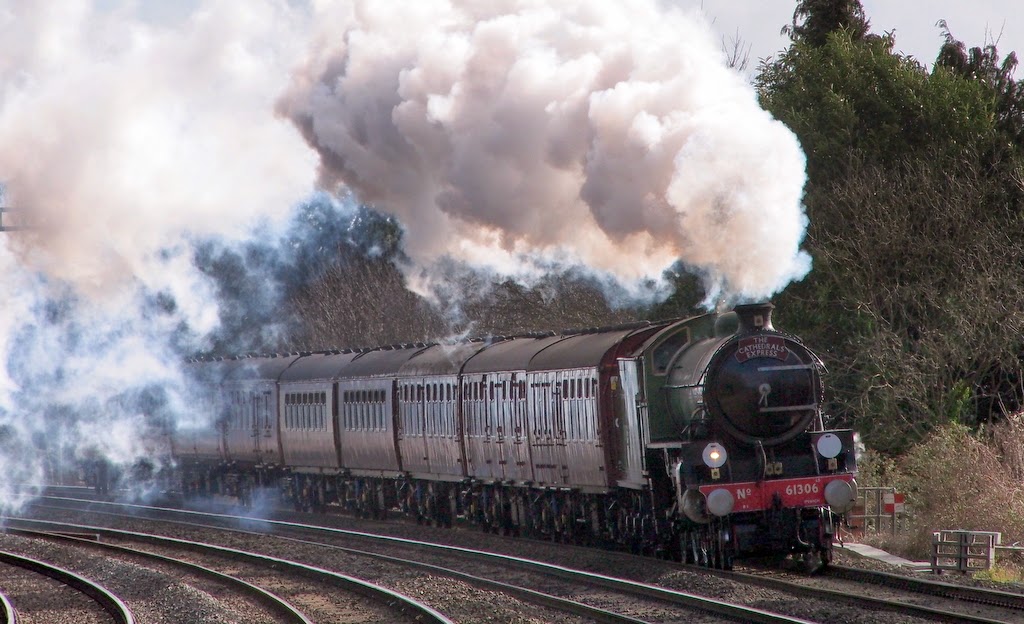
We also did some trainspotting recently. The local camera club that we belong to told us that a newly refurbished steam train was passing by in a few days, so we dutifully drove to Pangbourne station to watch it go by one Saturday morning. As we neared there we passed a chap on an old 10-speed cycle dressed up in tweeds, cap and rucksack. Vicki immediately identified him as a fellow trainspotter and he did appear on the platform with us. It turns out he restores old bicycles for a living and was immensely proud of his 1959 Raleigh in original purple. No one had warned us how different a main-line steam train is to the normal restored engines that putter along private tracks. We saw it in the distance and then, ten seconds later, it had flashed by. Oh well.


Spring continues with plenty of growth in the garden and lots of temptations for the local deer. We are forever battling to shore up the fence and keep them out. Tulips are a special favourite of theirs. And now we have a badger burrowing under the fence too. They will be near impossible to keep out as they can chew their way through wire if need be. We have two badger setts in our woods and it is not surprising that at least one is trying to get into the garden. Our concern is for our two chickens. Apparently if a fox gets in they will decimate the entire coop and leave body parts everywhere, whereas a badger will neatly take one away. Then come back for the next. And the next. By morning the coops will be empty.


We're looking forward to a busy few weeks..... next weekend we're planning a weekend near Frome with Gail and Janos (who are currently in snowy Iceland with their daughters); a week later we're celebrating Vicki's birthday with dinner and a show in London; and at the end of the month we're off to Morocco for a week, with a few days in Marrakesh and a three day tour to the desert with camel ride and camping in the dunes!  On our return to the UK, we'll have our fingers crossed that the UK Border Agency will stamp Vicki's passport with another six month visitor's visa - we're not yet finished with our travelling here and would like to spend another six months in the UK before moving on.


Sunday, 5 April 2015

Winter’s end

A long, cold, wet and grey northern winter? Actually, no. We’ve had very few rains here this winter which is the opposite of last year where there were torrential rains over much of the country and many floods, one of which temporarily trapped us in Cornwall when the train line was washed away. A couple of sprinklings of snow and quite a few frosts, with only the frosts interfering with outdoor work as you can’t walk on the grass when it is frosted as it will kill it.

We had expected to get away for more weekends but winter isn’t a great time to be out and exploring (often the daytime temperature only gets up to 3C. So apart from our trip down to Devon (reported in the previous post) our only memorable events were a trip to the grounds of Highclere Castle, another to Harry Potter World and a couple of short trips into the outskirts of London.

Highclere Castle is close to us and famous as the home of the Earl of Carnarvon.  Depending on your point of view he's known as a famous Egyptologist or an infamous foreign robber. Certainly famous/infamous – along with Howard Carter – for discovering the tomb of Tutankhamen.  These days the 'castle' is far better known as Downton Abbey. This is the reason why tickets to see inside the house are already booked out for this year! Hence our visit was only to the grounds, on the public walkways. Luckily England has a network of sign-posted public walkways across private land that have to be kept open. When we found our way into the grounds (the walkway signs were somewhat suspiciously non-obvious), on a day when the castle and grounds were closed, we had a peaceful walk past numerous large fields that seem to house only large oaks and moles. There is a nice little church and graveyard in the grounds along with a group of houses for the estate workers. It is hard to see the “castle” but we did get a few glimpses when the mist cleared.

Harry's room - the cupboard under the stairs
We had booked up a February visit to Harry Potter World with our nieces before Christmas (it is that popular). The location is the studio where the films were made, which is in Watford, just north of London. The complex is a huge hanger-like building with outdoor sets, all surrounded by a large car park. More like an American attraction than an English one. The tickets are for a timed entry which starts with a very short talk and then you are free to explore. Typically it takes three or more hours to get around everything. Even if you are not a Harry Potter fan it is a great chance to see the studio sets and workshops. What really surprises is the level of detail in the workmanship, even details in some items that either are not seen on the screen or are only in a background shot for a few seconds. It may have helped that there were eight films made so many of the sets and props could be reused. It was interesting to see some of the sets for interior rooms - they only had the parts that were in camera, so not every wall, and no ceilings. Rooms like the Grand Hall had no roof because the ceiling was filled in by CGI for each scene. A fascinating attraction but the stand-out highlight was the enormous scale model of Hogwarts Castle and grounds, built with incredible detail (every tile and shrub) as it was used for many exterior and fly-over shots.


The Great Hall

Gryfindor common room

Enjoying a butterbeer with my niece, Stephanie

Vicki at the gate of the Potters' residence


Diagon Alley


Our other trips away from home involved heading into London. One of the daughters of the owners here has a flat there where she goes to university. We’ve had a couple of occasions to take items of furniture to her which involves driving in (about an hour and a quarter) and we then take the opportunity to spend a couple of hours wandering around west London and the Kings Road area. A nice break.

Old and new on the Thames
Low tide on the Thames, at Chelsea


A spring update is on its way!

Saturday, 7 February 2015

Down in Devon


On the M5 for the beautiful sunset
Winter in the UK (think short daylight hours, cold and grey) is actually a good time to take short breaks. With hotels and B&Bs outside of the main centres relatively empty, there are some amazing deals to be had. We subscribe to sites like amazon and travelzoo which regularly drop tantalising holiday deals into my inbox in time for a breakfast read. We took advantage of having one of the owners’ daughters at home recently to take a 3-day break to Devon.  The deal we took was £99 ($200 NZ) for two nights for the two of us in a good hotel, inclusive of breakfasts, use of the gym/pool/sauna, and an evening meal for one night. Given that the evening meal was half of this price, they were almost paying us to stay!! We augmented this with a special-rate £39 for B&B in another hotel for our first night.

Me enjoying the seaside ...
Hotels everywhere
So this is how we ended up in an adequate, but tired hotel in Torquay, on the “English Riviera”.  Torquay, Paignton and Brixham seem to run together on the south coast, but they have all seen better days before cheap package holidays to Europe became the norm. Still full of hotels, from the grand through to Fawlty Towers and smaller. I imagine the place is packed in summer, presumably with families and those not wanting to fly overseas. But at this time of year we only saw pensioners. Hence we shouldn’t be surprised to end up in an American-themed diner at our hotel with only a couple of other couples. Which was better than the bar we shared with the barman later for a nightcap, after saying goodbye to the main chef who was leaving early, only having had three people for dinner. And this was a large hotel.

Shouldn’t complain – we were very lucky to be there at all. The week before leaving our car developed a “get gearbox serviced now” warning light on the dash along with intermittent gear-changing issues. Some Googling told us that it is a common problem and typically cost £600 to repair – quite a bit on a £1600 car. On the morning of our departure Vicki took the car to a local ex-Renault mechanic who diagnosed an errant ABS sensor in the front wheel giving the wrong signals to the gearbox. £100 and an hour later it was all sorted and we headed off down the motorway somewhat gingerly, though with increasing confidence over the next few days.

Houses overlooking Dartmouth
Torquay in the daylight was not a great improvement so we quickly headed down the coast to Dartmouth, which you approach from the other side of the Dart River and take a small car ferry to. The views are glorious looking up the river to the Dartmouth Naval college, and downstream to the castle at the entrance to the harbour. We met an 86 year old who pointed out his house on the wharf. He said it still impressed him to think that the house was there when the Mayflower docked outside before heading to America in 1620.

Dartmouth from the car ferry

The River Dart with the Naval College
Where the Mayflower docked
Our turn next


from a noticeboard on the river edge
400 years later the fort & houses still stand

Totnes High Street

Our final tourist stop on the day was Totnes. It is set in a very pretty location on the banks of the river and, with a long history, it is still full of many old buildings, indeed it has the most listed buildings per capita in the country. These days it is better known as a centre for New Age lifestylers. Apart from all the hippies wandering around, there are numerous interesting shops, not at all like the typical main street of an English town where almost all the shops are part of national chains. Strangely we spent half the time we had left there in the Army Surplus Store – a treasure trove of interesting paraphernalia. Not just the full Bear Grylls survival collection, but also telescopes, binoculars, proper outdoor clothes and … camera tripods. We are looking for another camera tripod and they almost had the right one. Almost. Sigh.

It is essential to have a GPS here where there are so many addresses. We have a borrowed one that is a bit out of date, occasionally leading us astray. We were quite sure that our big new hotel was not in the middle of a housing estate but Gary (Gary Garmin – get it?) wouldn’t be convinced otherwise. So good old Google on the smartphone found the very obscure lane that was their main entrance.

Our last full day away involved a trip up onto Dartmoor – the high and rugged area that takes up a significant portion of Devon. Lots of very narrow lanes with stones walls either side – not somewhere you want to meet a car or tractor coming the other way. A midweek winter morning was probably as quiet as it gets. The scenery is wild and spectacular, lots of big trees, rugged hillsides, lonely farms, little stone hamlets that time has passed by, stone bridges over wild streams, wild horses and wild weather. Actually, we weren’t wild about the weather as we had a bit of hail and Arctic wind-chill. A complete contrast to the quaint and gentle towns of the previous day but equally as interesting and photogenic.

An ancient "clapper" bridge


Wild horses


Buckfast Abbey church
We made a small excursion to Buckfast Abbey on the way back to the hotel. It is the home of Benedictine monks so is quite a complex. Inside everything looked in remarkably good condition, but made sense when we read it had only been built in the 1930s!


Heading home the following morning meant getting onto the M5 motorway and sitting at 70mph for hours on end. Luckily we found a reason to go cross country – a visit to “Clark's Village” in Street. This is the home to the original Clark's shoes. It is a small town with a huge shopping centre containing an outlet store for Clark's and dozens of other outlet shops. A good place to stop and shelter and shop. One new pair of bargain boots [for Nigel] later we were on the road again for home and back to work in the afternoon. Ahhh …