|
The snow-capped Atlas mountains
are at the top of the picture! |
Outside of school holidays travel from the
UK is cheap, so for our first trip 'abroad' we decided on somewhere exotic, warm, and where we hadn’t been before. And
cheap. Each day we get enticing offers
in our inbox from
Travelzoo (amongst
others) and both Spain and Malta had very good options, but Morocco was more
tantalising, especially as several members of the extended family had already been there
and reported back how wonderful it is. The timing was good too as earlier in
the year it can be quite cool, and any later and it is far too hot – it can get
to over 50C out near the desert where we wanted to go.
 |
| A culturally sensitively dressed tourist |

Marrakesh is the tourist centre of Morocco, and
it feels like it. Tourists everywhere and many of the them wearing inappropriate
clothes for an Islamic country. We had been told that two
days in Marrakesh was about right and by our third day we agreed with that. It
is small enough to walk everywhere if you are energetic, and given the wiggliness
of the alleys in the centre it does feel
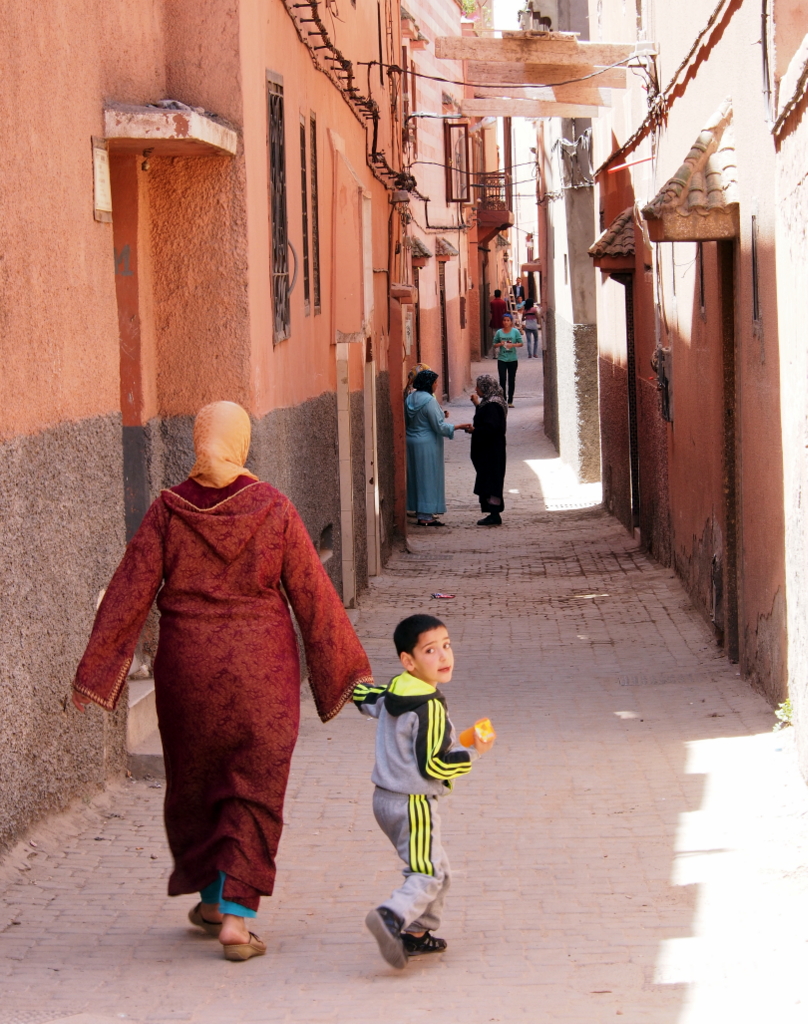
as if you have walked everywhere. With the narrow alleys it isn’t always possible to
get a GPS fix so at times it is easier to
accept an offer from a 'guide'. If you stand on a corner for but a moment a local man or boy
will approach you and offer to take you somewhere – usually at a blistering
pace, followed by a request for money.
 |
| Slippers, slippers, slippers ... |

For tourists the atmospheric medina area, the main square, the
souks, a couple of mosques and a palace, offer the most interest. For us, the best was probably just walking around the medina area taking in all the
sights and sounds. The souks (shopping areas) are wonderful and the little shops
seem to cater for locals (butchers, bright plastic household items) as well as
tourists. While it is famous for its leather (bags, coats, slippers), there are
many wonderful items for filling up a home from rugs to lamps to furniture. Lucky
we don’t have a home! We just had to go and see the 'tripadvisor' top-rated site in Marrakesh - 12,000 people just had to be right, surely? Well, the top-rated site is some gardens, and they were a big disappointment. They had some lovely specimen plants - huge bougainvilleas and many varieties of cacti were a highlight, but the whole place was manicured to within an inch of its life, with small paths carrying the masses of tourists. The challenge is that the narrow alleys are crowded but
still open to cycles, motorbikes and the odd donkey.
 |
| Need a musket? |
 |
| Fruit seller in Jemaa el-Fnaa square |
The main square is the centre point for locals and tourists
alike. It is here that you find singers, storytellers (though our understanding
of Berber is somewhat limited), snake-charmers, henna artists, jugglers, dried
fruit sellers, and the small stalls you would see at any fair. And numerous
stalls where you can sit down and enjoy wonderful food. Loud and exciting. One of the most memorable moments was watching a man with his monkey - they were unoccupied by tourists, so were quietly sitting on the ground, the man watching the world go by while the monkey searched his hair for a snack!
Most of the buildings are painted shades of red. Apparently Casablanca is white and there are blue villages ...
One of the ”attractions” is a visit to the tanneries. Every
day a self-appointed guide would offer to show us the way as “today is auction
day, much more interesting”. Well it is the smelliest place to visit, full of
pits containing liquid and a bundle of animal hides being processed, plus a
chap sloshing around in waders. The hides are subjected to washing in lime,
ammonia and pigeon poo! One section is full of Berbers who look after the
larger skins (camel, cow), the second section is the Arabs who work with the smaller
skins (goat, sheep, etc). Unfortunately it is only at certain times of the year
that they dye the skins and then the pits are full of the most amazingly bright
dyes. Not while we were there though.
 |
| 'Ministry of Works' vehicle |
 |
| Taxi ranks |
 |
| Inside an ex-palace |
 |
| Crushing argan nuts to make the oil |
 |
| Tagines! |
Though it was a struggle getting through an entire holiday
with nothing alcoholic to drink, the local food and drink mostly made up for
this. Oranges are a major crop, hence freshly-squeezed juice was readily available
and delicious. Apart from omelettes and
couscous dishes, tagines seemed a staple of most restaurants. And not
surprising is that food and drink is very cheap!
A quick bit of history: the original inhabitants - and still the majority - are the Berbers. They have their own language and customs. The Arabs, with their language and customs, arrived much later. These days they seem to mix more and inter-marry. French is their common language, though many in the tourist areas seem to also speak English, German, Italian, and Spanish. Very multilingual.
 |
| At least one of these palms is fake! |
Our next post will describe what we did for the rest of our
time in Morocco, our “desert adventure” …


 Marrakesh is the tourist centre of Morocco, and
it feels like it. Tourists everywhere and many of the them wearing inappropriate
clothes for an Islamic country. We had been told that two
days in Marrakesh was about right and by our third day we agreed with that. It
is small enough to walk everywhere if you are energetic, and given the wiggliness
of the alleys in the centre it does feel
as if you have walked everywhere. With the narrow alleys it isn’t always possible to
get a GPS fix so at times it is easier to
accept an offer from a 'guide'. If you stand on a corner for but a moment a local man or boy
will approach you and offer to take you somewhere – usually at a blistering
pace, followed by a request for money.
Marrakesh is the tourist centre of Morocco, and
it feels like it. Tourists everywhere and many of the them wearing inappropriate
clothes for an Islamic country. We had been told that two
days in Marrakesh was about right and by our third day we agreed with that. It
is small enough to walk everywhere if you are energetic, and given the wiggliness
of the alleys in the centre it does feel
as if you have walked everywhere. With the narrow alleys it isn’t always possible to
get a GPS fix so at times it is easier to
accept an offer from a 'guide'. If you stand on a corner for but a moment a local man or boy
will approach you and offer to take you somewhere – usually at a blistering
pace, followed by a request for money.
 For tourists the atmospheric medina area, the main square, the
souks, a couple of mosques and a palace, offer the most interest. For us, the best was probably just walking around the medina area taking in all the
sights and sounds. The souks (shopping areas) are wonderful and the little shops
seem to cater for locals (butchers, bright plastic household items) as well as
tourists. While it is famous for its leather (bags, coats, slippers), there are
many wonderful items for filling up a home from rugs to lamps to furniture. Lucky
we don’t have a home! We just had to go and see the 'tripadvisor' top-rated site in Marrakesh - 12,000 people just had to be right, surely? Well, the top-rated site is some gardens, and they were a big disappointment. They had some lovely specimen plants - huge bougainvilleas and many varieties of cacti were a highlight, but the whole place was manicured to within an inch of its life, with small paths carrying the masses of tourists. The challenge is that the narrow alleys are crowded but
still open to cycles, motorbikes and the odd donkey.
For tourists the atmospheric medina area, the main square, the
souks, a couple of mosques and a palace, offer the most interest. For us, the best was probably just walking around the medina area taking in all the
sights and sounds. The souks (shopping areas) are wonderful and the little shops
seem to cater for locals (butchers, bright plastic household items) as well as
tourists. While it is famous for its leather (bags, coats, slippers), there are
many wonderful items for filling up a home from rugs to lamps to furniture. Lucky
we don’t have a home! We just had to go and see the 'tripadvisor' top-rated site in Marrakesh - 12,000 people just had to be right, surely? Well, the top-rated site is some gardens, and they were a big disappointment. They had some lovely specimen plants - huge bougainvilleas and many varieties of cacti were a highlight, but the whole place was manicured to within an inch of its life, with small paths carrying the masses of tourists. The challenge is that the narrow alleys are crowded but
still open to cycles, motorbikes and the odd donkey.